

 Shopping Cart
23 October 2026
Are Rainwater Tanks Worth It in New Zealand? Costs, Payback and Safety in 2026

First published 17 January 2022 and updated 23 October 2026
Are rainwater tanks worth it? For most New Zealand homes, yes. But the reasons have shifted since we first answered this question in 2022, and the honest answer now depends on where you live, what you pay for water and what you plan to use the tank for.
Three things have changed. Water has become more expensive: Watercare's water and wastewater prices in Auckland rose 7.2% from 1 July 2026. Drought is becoming more likely, with Earth Sciences New Zealand (formerly NIWA) expecting a strong El Niño to peak over the 2026/27 summer. And installing a tank has become simpler, with most Auckland homes no longer needing resource consent for one.
This guide covers what a tank really costs, how long it takes to pay for itself using New Zealand research from BRANZ, what tank water is safe to use for, and how to make sure you never run dry. You can also work out your own payback with our free calculator.
The quick answer
A rainwater tank is worth it in New Zealand if you want water security during restrictions, a reliable supply for your garden, or protection against the dry summers that are becoming more common. Financially, it pays off best where water is charged by volume. BRANZ research put Auckland payback at around 13 to 14 years on 2015 prices; with Auckland's 2026 water and wastewater charges, our updated estimate for a typical three-person household is far shorter, depending mainly on what your installation costs. A well-installed tank should last 20 to 25 years.
Why more Kiwis are installing rainwater tanks in 2026
Water is getting more expensive
In Auckland, Watercare is investing $13.8 billion over the next decade in water and wastewater infrastructure, and from 1 July 2026 its prices rose by 7.2% (Franklin Times). Water now costs $2.46 per 1,000 litres, and wastewater $4.28 per 1,000 litres, charged on 78.5% of the water your meter records (Watercare charges 2026/27).
That second charge matters more than most people realise. Because wastewater is billed as a share of metered water, every 1,000 litres of rainwater you use instead of mains water saves you about $5.82, not just $2.46. Water used on the garden is billed as wastewater too, even though it never goes down the drain.
Drier summers are becoming more likely
Climate projections from Earth Sciences New Zealand (formerly NIWA) show drought conditions becoming more frequent in northern and eastern New Zealand, with the time those areas spend in drought projected to double or triple by around 2040 (Earth Sciences NZ). Interestingly, the same projections show little change in total annual rainfall for northern regions. The rain still comes, but less predictably, with more dry days in between. That is exactly the gap a tank fills: it stores rain from wet spells so you can use it through dry ones.
Installing a tank has become easier
In the past, the biggest objections to tanks were space and red tape. Slimline tanks that sit against a wall or fence line have largely solved the space problem, and in 2022 Auckland Council removed much of the red tape. A plan change took rainwater tanks out of the definition of a "building" and made them a permitted activity in most zones, so most Auckland homeowners no longer need resource consent or pay a consent fee to install one (Auckland Council). Building consent is still needed if the tank is connected to internal plumbing.
Water restrictions and the 2026/27 El Niño summer
Aucklanders will remember the last major drought. Outdoor water restrictions began on 16 May 2020, after a record-breaking dry spell dropped the region's dam levels to 42.5%, and the last of them were not lifted until 23 October 2021 (Auckland Council). For 17 months, sprinklers were banned and households had to rethink how they watered their gardens. When the restrictions ended, Watercare was clear that mandatory restrictions remain a tool for managing severe droughts in future.
This summer brings a fresh test. Earth Sciences New Zealand declared El Niño conditions in mid-2026 and expects them to peak over the 2026/27 summer, with about a 90% likelihood that the event reaches or exceeds very strong intensity (Earth Sciences NZ, Aug to Oct 2026 outlook). El Niño typically brings more westerly winds to New Zealand, which tends to mean drier, warmer conditions in the north and east and wetter weather in the west and south. Forecasters also expect the heavy rain events from the north that soaked many regions over the past year to become less frequent (Earth Sciences NZ, Sep to Nov 2026 outlook).
Seasonal outlooks are probabilities, not guarantees, and this one could change. But the practical advice is the same either way: a tank fills from rain, so it needs to be in place and full before the dry months arrive, not installed in the middle of them. We cover how to prepare in more detail in El Niño in 2026: why now is the time to track tank water and plan ahead.
How long does a rainwater tank take to pay for itself?
The most thorough New Zealand answer comes from BRANZ, the building research body, which modelled rainwater tanks in six cities. Its findings are a useful starting point, and Auckland's 2026 water charges change the picture considerably.
What BRANZ found
BRANZ calculated payback as the full cost of the tank, pump, plumbing and electrical work divided by the yearly saving on water charges (BRANZ Valuing Sustainability #2). It assumed each person uses 180 litres of water a day, of which about 58% (toilet flushing, the washing machine and outdoor use) can be supplied by rainwater. Tanks were sized to each city's summer rainfall, capped at 10,000 litres, and installed costs ranged from $2,550 to $4,250 at late-2015 prices.
BRANZ treats a payback of 15 years as roughly equal to a 5% return on the money spent, and anything longer as uneconomic in purely financial terms (BRANZ Facts: Harvesting Rainwater #6).
| City | Payback (BRANZ, 2015 prices) | Tank for a 3-person household | Share of peak summer demand met |
| Nelson | 10 to 11 years | 5,500 litres | 83% |
| Auckland | 13 to 14 years | 5,500 litres | 86% |
| Wellington | 13 to 15 years | 5,500 litres | 91% |
| Tauranga | 13 to 16 years | 5,500 litres | 98% |
| Dunedin | 17 to 21 years | 3,500 litres | 63% |
| Christchurch | 28 to 42 years | 3,500 litres | 50% |
The gap between cities comes down to two things: how councils charge for water, and how much rain falls in summer. Christchurch and Dunedin had long paybacks because of relatively low water charges and lower summer rainfall. BRANZ also noted that where water and wastewater are not charged by volume, as in most areas outside Auckland at the time, a tank will not cut your bill at all.
What has changed since
BRANZ priced Auckland water for a typical three-person household at about 0.24 cents per litre. Today, the volumetric charge alone is about 0.58 cents per litre once wastewater is included, more than double. Using BRANZ's own model of how much mains water a tank replaces (about 102,500 litres a year for that household), the yearly saving rises from BRANZ's $246 to roughly $597 on 2026 Watercare charges.
We have counted only the per-litre charges. Fixed charges stay the same whether or not you have a tank, so including them would overstate the saving.
The big unknown is installation cost. BRANZ's figures are from 2015, and building costs have risen since. The table shows how payback changes with the installed price, for an Auckland household of three with a 5,500 litre tank, assuming no future price rises.
| Installed cost | Payback | Payback including Smart Water monitoring ($699) |
| $3,050 (BRANZ 2015 figure) | about 5 years | about 6 years |
| $5,000 | about 8.5 years | about 9.5 years |
| $8,000 | about 13.5 years | about 14.5 years |
| $10,000 | about 17 years | about 18 years |
These are estimates from a model, not guarantees. Your rainfall, roof, household and habits will all make a difference, so get a quote and run your own numbers below. If water prices keep rising, as they did in 2026, payback shortens further.
Rainwater tank payback calculator
Built on BRANZ research into New Zealand households, updated with 2026 water charges. Change any figure to match your own quote and council.
The six cities BRANZ modelled, using each city's rainfall pattern.
House size sets the roof area collecting rain.
Watercare from 1 July 2026: $2.46.
Pre-filled with BRANZ's 2015 cost for this tank size. Replace with your own quote for an accurate result.
Watercare charges $4.28 per 1,000 litres on 78.5% of metered water. Untick if your council does not charge wastewater by volume.
Adds a Desk Mount WiFi LCD Starter Pack ($699) to the upfront cost.
Advanced settings
Set to 0 for a cautious estimate. Watercare prices rose 7.2% in July 2026.
Pump power, filters and maintenance. BRANZ left these out; add your own estimate.
Estimated payback
-Saving per year
-Mains water replaced
-Net gain over 20 years
-Estimates only. Water replaced is BRANZ's modelled figure for toilet, laundry and outdoor use at 180 litres per person per day; your rainfall, roof and habits will differ. Savings count volumetric charges only, because fixed charges stay the same with or without a tank. Sources: BRANZ Valuing Sustainability #2 (2016), Watercare charges 2026/27.
See Smart Water starter packsGetting a faster payback
• Plumb the tank into your toilet and laundry. These run all year, so the tank keeps earning in winter, not just when you water the garden. Building consent is needed for this.
• Connect as much roof as possible. More roof area means more rain captured in every shower.
• Use less water overall. BRANZ found that switching to a front-loading washing machine and a low-flow shower head could cut use by up to 33% for high-use households (BRANZ Facts: Harvesting Rainwater #5).
• Check how your council charges. At least 22 councils charge households directly for water by volume, according to a 2026 review by TDB Advisory (TDB Water Pricing Review), but many do not. If yours does not, a tank will not lower your bill, though every other benefit still applies.
The benefits that do not show up on your bill
Keep your garden green through restrictions
When restrictions banned sprinklers across Auckland in 2020 and 2021, gardens suffered. With a tank, you can use the rain you stored over winter to keep lawns, vegetables and plants alive through a dry summer, without touching the mains. Outdoor watering is also a big share of household use: in a BRANZ study of 51 Auckland homes, about 17% of summer water went on the garden and other outdoor uses (BRANZ).
Many gardeners also prefer rainwater to treated tap water for their plants. We look at why in does rainwater have nutrients?
Reduce stormwater runoff
When rain runs off roofs, roads and driveways, it picks up oil, metals, fertilisers, pesticides and bacteria and carries them into streams, rivers and harbours. Heavy downpours can also overwhelm stormwater networks. Every litre your tank captures is a litre that does not add to that runoff.
One point for Auckland homeowners: if your property needs a tank for stormwater management, for example under the Stormwater Management Area Flow (SMAF) rules, that tank is treated differently. A tank required to detain and slowly release stormwater does not count as a "rainwater tank" under the Unitary Plan, so check what your consent requires before planning to use it for supply (Auckland Design Manual).
Resilience when the mains fail
A tank is also an emergency supply. BRANZ notes that after a major earthquake on the Wellington Fault, normal water supply may not be available for two months, and some residents could wait more than three (BRANZ). Floods, cyclones and pipe failures can also cut supply. Stored water will not be drinkable without treatment, but it can flush toilets, wash hands and clean up while the network is repaired.
What can you use tank water for?
Most people are comfortable using rainwater outside the house. In a BRANZ survey, around 90% of respondents agreed it was fine for toilet flushing, laundry and garden watering, while only around half thought it acceptable for drinking and cooking (BRANZ). That instinct is sound: the further rainwater goes towards your mouth, the more treatment it needs.
| Use | What you need |
| Garden, lawn, car washing | Gutter guards and a basic screen |
| Toilet flushing | A pump, plumbing to the cistern and building consent |
| Laundry | As above, plus a sediment filter to protect the machine |
| Showering and bathing | Filtration and UV treatment, maintained to the maker's schedule |
| Drinking and cooking | First-flush diverter, filtration, UV treatment and regular water testing |
Is rainwater safe to drink?
Not without treatment. Rain itself is fairly clean, but on its way into your tank it picks up whatever is on your roof and in your gutters: dust, leaves, bird and possum droppings, and sometimes residue from roofing materials. Bacteria and parasites from droppings are the most common cause of illness from untreated tank water.
There is also a newer concern. A 2022 study led by Stockholm University and published in Environmental Science & Technology found PFAS, the so-called "forever chemicals", in rainwater worldwide at levels above recent US drinking water advisory values. New Zealand's own Drinking Water Standards have included a maximum acceptable value for PFAS since November 2022 (Watercare). PFAS are not removed by UV, so if this concerns you, ask a water treatment specialist which filtration options are tested for them.
If you plan to drink your tank water:
- Keep the catchment clean. Fit gutter guards, keep overhanging branches cut back and clean gutters regularly.
- Fit a first-flush diverter. This sends the first, dirtiest water from each shower to waste.
- Treat at the tap. A typical household setup combines sediment filtration with a UV steriliser. Replace filters and UV lamps on schedule.
- Test regularly. Have your water tested by an accredited laboratory, and again after any problem such as a dead animal in the gutter or a flood.
- Look after the tank. Check for sediment build-up and make sure lids and inlets keep out light, insects and animals. Our guide to how to filter rainwater has more detail.
Do the drinking water rules apply to me?
A single home supplied by its own rainwater tank is a "domestic self-supply" and is not covered by the drinking water supplier rules administered by Taumata Arowai, the water services regulator. That includes a single rented house or holiday home on its own tank.
If your tank supplies drinking water to more than one household, for example a main house and a separate rented cottage, or a café or farm stay on your property, you are likely to be a drinking water supplier with legal duties, including registration (Taumata Arowai). Since September 2025, an Acceptable Solution has given self-supplied buildings of up to 500 people a simpler way to comply (Taumata Arowai). Water rules have been reformed several times in recent years, so check the Taumata Arowai website for the current position on your property.
Do I need consent for a rainwater tank?
In Auckland, most homeowners do not need resource consent for a rainwater tank, as long as it meets the simple standards for their zone, such as height and distance from the boundary. You will still need building consent if the tank is connected to your internal plumbing, for toilets or laundry for example.
Rules differ around the country. Some councils actively encourage tanks, and Kapiti Coast District Council has required new homes to include a rainwater tank (or a smaller tank plus a greywater system) (BRANZ). Always check with your local council before you buy.
How long do rainwater tanks last?
A good-quality, well-maintained rainwater tank should last 20 to 25 years. How long yours lasts depends on the material, where it sits (sun exposure and a stable, level base both matter) and how well it is looked after.
A simple maintenance routine protects both the tank and the water in it:
• Clean gutters and gutter guards every few months, more often under trees.
• Empty or check the first-flush diverter after heavy rain.
• Inspect the tank inlet, overflow and lid seals each year.
• Check for sediment and have the tank cleaned when it builds up.
• If you drink the water, replace filters and UV lamps on the maker's schedule.
Not sure what size you need, or where to put it? See what size water tank do I need? and where is the best place to put a rainwater tank?
Why monitoring is what makes a tank worth it
A tank only pays its way if you use the water in it, and you can only plan your use if you know how much is there. Without monitoring, most people find out their tank is empty when the tap runs dry, usually in the middle of a dry spell. With it, a tank becomes a supply you can manage like any other.
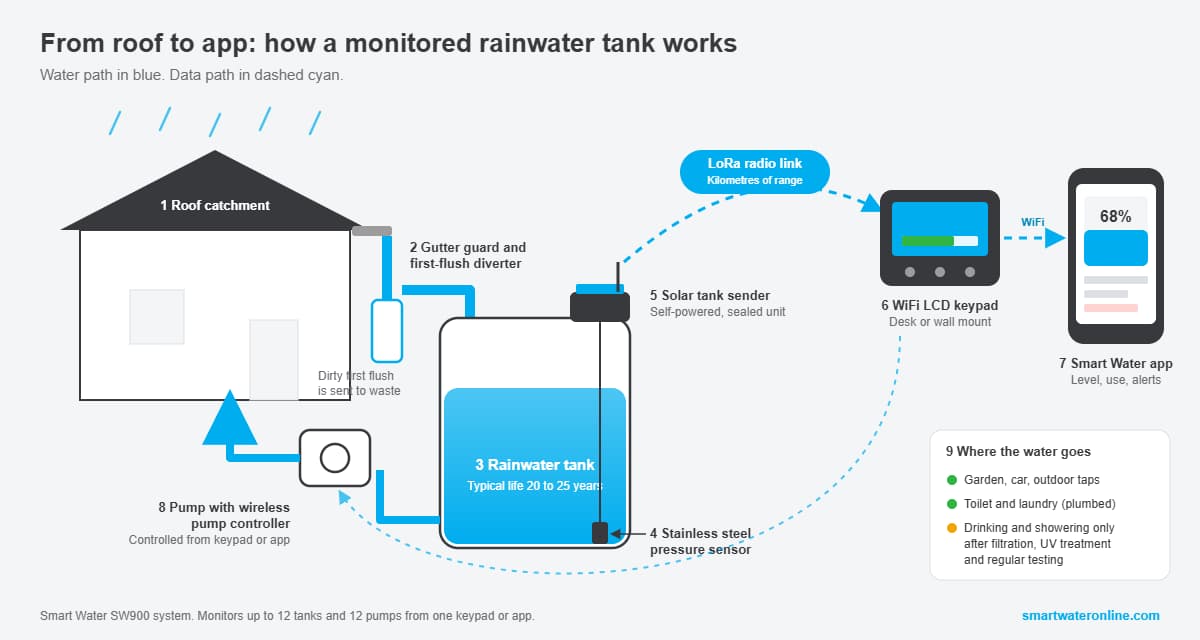
How the Smart Water system works
Our SW900 system is designed for DIY installation and has four main parts:
• A stainless steel pressure sensor sits at the bottom of the tank and measures the water level. It works in tanks up to 5 metres deep, above or below ground.
• A solar-powered tank sender on the tank collects the readings. It is fully sealed, with a lithium-ion battery recharged by its built-in solar panel, and can run for three to six months without direct sunlight. Tanks with no sun at all, such as underground tanks, can run from the power supply provided.
• A WiFi LCD keypad (desk or wall mount) receives the data over our long-range LoRa radio network. The standard range is 5 to 10 km with clear line of sight, so you do not need WiFi or mobile coverage at the tank.
• The Smart Water app
One system can monitor up to 12 tanks and control up to 12 pumps, so you can start with one tank and add more later.
What it tells you
The system starts learning your water use from the day it is installed. After a couple of weeks it shows your average daily use and estimates how many days of water you have left. It can then warn you about:
• Low days remaining, so you can cut back or arrange a top-up before you run out.
• Abnormal usage, such as a burst pipe or a tap left running, typically flagged within three to four hours.
• Low battery on any tank sender.
Over time, your usage history shows how much water you draw from the tank, which gives you a far better basis for estimating your savings than guesswork.
Pump control
Add a wireless pump controller and you can manage your pump from the keypad or app, with automatic start and stop settings. Premium app users can also set pump schedules by date and time.
Remote and rural properties
New Zealand's mobile networks completed the switch-off of 3G in March 2026. Because the core Smart Water system talks to the tank over its own LoRa radio link and to the internet over your home WiFi, it does not rely on mobile coverage. Where there is no line of sight from the tank to a building with power and WiFi, our Off-Grid 4G Tank Monitoring System adds an 84W solar panel, deep-cycle battery and 4G/LTE WiFi hotspot so you can monitor and control very remote tanks.
Choosing your setup
| If you have | Start with | Price (NZD) |
| One tank near the house | Desk Mount or Wall Mount WiFi LCD Starter Pack | $699 |
| Two tanks | Desk Mount or Wall Mount Starter Pack, 2 Tank | $999 |
| A tank with a pump to control | A starter pack plus a Wireless Pump Controller | $699 + $369 |
| A remote tank with no line of sight | Off-Grid 4G Tank Monitoring System | $1,299 |
| An existing system and a new tank | Tank Level Sender Complete Kit | $399 |
The basic app is free. A premium subscription (NZ$29.99 a year) adds push notifications, multiple systems, pump scheduling and system sharing. All Smart Water products carry a two-year warranty. See the full product range or find a local stockist.
Going further: greywater
If you want to cut mains use even more, greywater from showers and baths can be reused for garden watering or toilet flushing. BRANZ found that outdoor use and toilet flushing together make up over a third of a typical Auckland household's summer water use, so reusing greywater for those alone could cut mains use by more than a third (BRANZ). Greywater systems have their own rules, so talk to your council first.
The verdict: are rainwater tanks worth it?
For most New Zealand homes, yes. A tank gives you water through restrictions, keeps your garden alive in a dry summer, cuts stormwater runoff and provides an emergency supply when the mains fail. With a strong El Niño forecast to peak this summer, those benefits are more relevant now than at any time since the 2020 drought.
Financially, the case is strongest where water and wastewater are charged by volume, as in Auckland, and where the tank is plumbed into toilets and laundry as well as the garden. On 2026 Auckland charges, BRANZ's model suggests a tank can pay for itself well within its 20 to 25 year life, though your installed cost makes the biggest difference. Where water is not charged by volume, buy a tank for resilience rather than savings.
Whichever applies to you, monitoring is what turns a tank from a guess into a supply you can plan around. Explore Smart Water starter packs.
Frequently asked questions
Are rainwater tanks worth installing in New Zealand homes?
For most homes, yes. A tank provides water during restrictions, keeps gardens green in dry summers, reduces stormwater runoff and acts as an emergency supply. It saves money where water is charged by volume, such as in Auckland, and lasts 20 to 25 years if well maintained.
How long does a rainwater tank take to pay for itself in NZ?
BRANZ calculated paybacks of about 10 to 11 years in Nelson and 13 to 14 years in Auckland on 2015 prices, and much longer in Christchurch. Auckland's 2026 water and wastewater charges shorten that considerably; for a three-person household, payback ranges from about 5 to 17 years depending on installation cost. Use our calculator for your own estimate.
How can a rainwater tank save me money?
Every litre of rainwater you use replaces a litre of metered mains water. In Auckland, that saves both the water charge ($2.46 per 1,000 litres) and the wastewater charge, which is billed on 78.5% of metered water, a combined saving of about $5.82 per 1,000 litres in 2026/27.
Is rainwater safe to drink in New Zealand?
Not without treatment. Roof water can carry bacteria from bird and possum droppings, and research has found PFAS chemicals in rainwater worldwide. If you drink tank water, use gutter guards, a first-flush diverter, filtration and UV treatment, and have the water tested regularly by an accredited laboratory.
Do I need consent for a rainwater tank in Auckland?
Usually not resource consent. Since a 2022 plan change, most residential rainwater tanks are a permitted activity in Auckland if they meet the standards for your zone. You still need building consent if the tank connects to internal plumbing, such as toilets or laundry. Other councils have their own rules.
How long do rainwater tanks last?
A good-quality, well-maintained rainwater tank should last 20 to 25 years. Lifespan depends on the tank material, a stable and level base, sun exposure and regular maintenance of gutters, inlets and seals.
How do I know how much water is in my tank?
A tank level monitor measures the water level and sends it to a display or app. The Smart Water system uses a pressure sensor and a solar-powered tank sender to show your level, average daily use and days remaining on a WiFi keypad or the Smart Water app, with alerts for low levels and abnormal usage.
What size rainwater tank do I need?
It depends on your household, roof area, local rainfall and what you will use the water for. BRANZ sized tanks of about 3,500 litres for two people and 5,500 litres for three people in Auckland to supply toilet, laundry and outdoor use. See our guide: what size water tank do I need?
Should I install a tank before an El Niño summer?
Yes, if you can. A tank fills from rain, so installing it in spring gives it time to fill before the dry months. Earth Sciences New Zealand expects El Niño to peak over the 2026/27 summer, which typically brings drier conditions to the north and east of the country.