
 Shopping Cart
30 October 2026
Smart Water Tank Level Indicators: Know What's in Every Tank

Post first published January 2025 and last updated October 2026.
Introduction
New Zealand is heading into a summer shaped by one of the strongest El Niño events on record. Earth Sciences New Zealand expects northern and eastern regions to be drier than normal, with conditions not settling until autumn 2027. Water is costing more too: Auckland's water and wastewater charges rose 7.2% in July.
If your home, farm or business runs on a tank, the question this summer is not just how full it is. It’s how many days of water you have left, whether something is leaking, and whether your pump will keep running when you are not there. A smart tank level indicator answers all three, from your phone or a screen on your wall.
What is a smart water tank level indicator?
A smart water tank level indicator measures how much water is in your tank and sends the reading to a display or phone app. Smart Water's system uses a submersible pressure sensor and a solar-powered sender. Over time, it learns your usage, shows how many days of water you have left and alerts you to abnormal usage.
Unlike a float gauge or a quick look through the inspection hatch, it keeps watching when you are not. It also turns a single number, the level, into information you can plan around.
Why tank visibility matters more in 2026/27
In New Zealand, a dry summer is likely. Earth Sciences New Zealand declared El Niño in July 2026 and expects it to peak around November or December. Strong El Niño summers have historically been dry in the north and east of both islands. For anyone on rainwater, that means less refill and more demand at the same time, and rural households that rely on tanks are among the most exposed to shortages.
In Australia, the south-east is the area to watch. The Bureau of Meteorology expects El Niño to persist through spring and summer, with a warmer outlook and early heat risk in the south. It also notes that a strong El Niño does not always bring equally strong rainfall impacts, which is exactly why real data from your own tank beats a seasonal guess.
Water from the mains is getting dearer. Auckland's water price rose from $2.296 to $2.46 per 1,000 litres in July 2026, and several councils now bill water separately under Local Water Done Well. If you top up your tank from the mains, or use tank water to cut your bill, every litre you can see and manage now counts for more.
Knowing your days remaining turns a stressful guessing game into a plan.
How it works: pressure sensing explained
The deeper the water, the harder it presses down. Every metre of water adds roughly 0.1 bar of pressure at the bottom of your tank. Smart Water's stainless steel sensor sits on the tank floor and measures that pressure, and the tank sender converts it into a water level. The standard system suits tanks up to 5 m deep, and a 10 m sensor is available for deeper tanks.
The solar-powered sender then sends the reading by long-range radio to a WiFi LCD keypad inside your home, shed or office, typically 5 to 10 km away in clear line of sight. The keypad shows the level and trends on its touchscreen, and passes the data to the Smart Water app over your home WiFi. There is no need for WiFi at the tank itself.
Pressure, ultrasonic and radar compared
There are three common ways to measure a tank. Each has its place; here is why Smart Water uses pressure.
| Submersible pressure (Smart Water) | Ultrasonic | Radar | |
| Where it sits | On the tank floor, with a cable to the sender | At the top of the tank, facing down | At the top of the tank, facing down |
| How it measures | Water pressure from depth | Time for a sound pulse to echo off the surface | Time for a radio pulse to reflect off the surface |
| Strengths | Not affected by condensation, foam or ripples; suits enclosed and underground tanks | No contact with the water; simple to retrofit | No contact with the water; generally less affected by vapour and temperature than ultrasonic |
| Things to know | The sensor sits in the water, so it needs marine-grade materials | Condensation, foam and a blind zone near the sensor can affect readings | Generally the most expensive option |
Smart Water's sensors are built from marine-grade SS316 stainless steel with a UV and weather-resistant vented cable, and the sensing element is rated to ±0.1% accuracy.
From a reading to a decision: what the data tells you
A level reading tells you where you are. Smart Water tells you where you are heading. From the moment it is installed, the system starts learning how much water you use. After a couple of weeks, it can show your average daily use and how many days of water are left, and warn you with a Low Days Remaining alert when supply is running down.
That changes the decisions you make. You can book a water delivery before you are down to the last few hundred litres, ease off the garden before restrictions bite, or spot that the stock tank is emptying faster than the herd can drink.
See your days of water left, not just the level. Every Smart Water Starter Pack includes a keypad, solar tank sender and stainless steel sensor, ready for DIY installation.
Four ways monitoring pays for itself
1. Cost savings
The most expensive water is the water you lose without knowing. A leak can drain a tank for days before anyone notices, and on an off-grid property that can mean paying for an emergency delivery. Catching problems early, planning deliveries in advance and automating when your pumps start and stop all cut costs that are easy to miss until they arrive.
2. Leak prevention
Smart Water compares what your tank is doing with your normal pattern of use. If water is leaving faster than it should, the system raises an Abnormal Usage alert, typically within three to four hours. That is the difference between finding a burst pipe the same day and finding an empty tank at the weekend.
3. Off-grid reliability
Off-grid systems need to keep working when the internet and the weather do not. The tank sender is solar powered, with a sealed battery that can run for three to six months without direct sun. It talks to your keypad over Smart Water's own long-range radio, so the tank does not need WiFi or mobile coverage. If the power goes off, the system reconnects on its own when it returns.
4. Drought and emergency preparedness
In a dry summer, the most useful number is not litres in the tank but days left. Smart Water forecasts days remaining from your actual usage and warns you when it drops. It is also worth keeping firefighting in mind: Fire and Emergency NZ has urged rural property owners to keep water supplies such as tanks accessible this El Niño season.
Running more than one tank, or a pump? Add up to 12 tank senders and 12 wireless pump controllers to one system. Set start and stop levels, timers and tank-to-tank or bore-to-tank pumping, and get alerts if a pump reports a problem.
View Tank Senders · View Pump Controllers
How the Smart Water system fits together
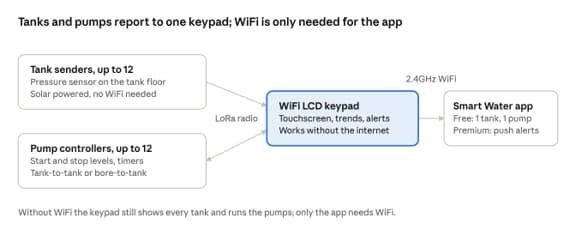
Every Smart Water system starts with a WiFi LCD keypad, the hub that collects data from up to 12 tank senders and up to 12 pump controllers over Smart Water's long-range LoRa radio network. Each tank has a stainless steel pressure sensor connected to a solar-powered sender. The keypad shows everything on its touchscreen and, when connected to your 2.4GHz WiFi, passes it to the Smart Water app so you can check in from anywhere.
- Tank senders measure each tank and report the level by radio. Tanks that are joined together and rise and fall as one need only one sender.
- Wireless pump controllers switch pumps on and off at the levels and times you set, including tank-to-tank and bore-to-tank pumping.
- The WiFi LCD Keypad
shows levels, trends and alerts on a 2.8-inch touchscreen, on your desk or set into a wall. - The Smart Water app
puts it all on your phone. The basic app is free; Premium adds push notifications, more tanks and systems, pump schedules and sharing for NZD 29.99 a year.
You do not need the app or the internet for the system to run. Without WiFi, the keypad still shows every tank and runs your pumps.
Smart monitoring vs traditional checks
| What you need to know | Smart Water | Float gauge or manual check |
| How full is the tank right now? | Live on the keypad and app | Only when someone looks |
| How many days of water are left? | Calculated from your actual usage | Guesswork |
| Is something leaking? | Abnormal Usage alert within hours | Found when the tank is low |
| What happens while I am away? | Visible in the app; Premium sends push alerts | Nothing until you return |
| Can I see several tanks at once? | Up to 12 on one screen | One trip per tank |
| Can the pump run itself? | Start and stop levels, timers, routing | Manual switching or a float switch |
Installing and maintaining your system
Smart Water is designed for DIY installation. Here is how it goes:
- Lower the stainless steel sensor to the floor of the tank, with any spare cable.
- Fix the tank sender where its solar panel gets sun, ideally facing north in New Zealand and Australia (south in the US).
- Place the keypad indoors. The desk model plugs into USB; the wall model connects to mains power, so have an electrician fit it.
- Connect the keypad to your 2.4GHz WiFi through the app, and add each tank.
- Give the system a couple of weeks to learn your usage before relying on days remaining.
There is no battery to change: the sender is sealed and recharges from its solar panel, and the system warns you if a battery runs low. Software updates install automatically when the keypad is online. Step-by-step guides are in the manuals section, and you can see real setups in our installations gallery.
Which setup is right for you?
| If you have | Start with | Add when you need it |
| A suburban rainwater tank for garden use | Desk or Wall Mount WiFi LCD Starter Pack | Premium app for phone alerts |
| An off-grid home on one tank | Starter Pack, or the 10 m sensor version for deeper tanks | Premium app; a high-gain antenna if the keypad is far from the tank |
| A tank and a pump to automate | Starter Pack PRO, which includes a 230VAC wireless pump controller | Extra pump controllers, up to 12 |
| A farm with house, stock and irrigation tanks | 2 Tank Starter Pack | Tank Level Sender Complete Kits, up to 12 tanks; pump controllers |
| A new build with an underground tank | Starter Pack, with the sender running from its 12VDC power supply | Plan the cable route with your builder or plumber early |
Not sure? Your local Smart Water stockist can help you choose and install.
Frequently asked questions (2026/27)
Do I need WiFi at my tank?
No. Tank senders and pump controllers talk to the keypad over Smart Water's long-range LoRa radio, with 5 to 10 km of line-of-sight range as standard. You only need 2.4GHz WiFi at the keypad if you want to use the app. Without the app, the system runs without the internet.
How quickly will it tell me about a leak?
Smart Water raises an Abnormal Usage alert when water leaves the tank faster than your normal pattern, typically after three to four hours. Alerts show on the keypad and, with the Premium app, as push notifications on your phone.
How does monitoring help during an El Niño summer?
It shows how many days of water you have left based on your real usage, and warns you when that number drops. That gives you time to cut back, book a delivery or fix a leak before supply becomes urgent.
Can I install it myself?
Yes. The system is designed for DIY installation and no technical skills are needed. The exception is the Wall Mount keypad, which connects to mains power and should be fitted by an electrician. Pump controllers and any new tanks or plumbing changes may need a qualified electrician or plumber, so check locally.
Is there a subscription?
No subscription is needed to use the system. The basic app is free for one tank and one pump. Premium costs NZD 29.99 a year and adds push notifications, unlimited tanks and systems, pump schedules and sharing.
How deep can my tank be?
The standard system measures tanks up to 5 m deep. A 10 m sensor is available for deeper tanks.
Does it work with underground tanks?
Yes. The sensor works in freestanding and underground tanks. If the sender cannot get sunlight, run it from the 12VDC power supply included in the kit, or recharge it from time to time.
How many tanks can I monitor?
Up to 12 tanks and 12 pump controllers on one system. Tanks that are interconnected and rise and fall together need only one sender.
Does it work with smart home systems?
Not at present. Smart Water runs on its own keypad and app, so it does not rely on any other platform.
Are there council rebates for tank monitoring?
Rebates in New Zealand and Australia are run locally and change often, and most fund the tank itself rather than monitoring. Check your council or water provider's website before you buy.
Will my older SW800 equipment work with the SW900 system?
No. SW900 uses a new communications protocol and is not compatible with SW800. Replacement parts are still available in the SW800 Legacy Parts section.
More answers are in our full FAQs.
Be ready for a dry summer
Water security this summer comes down to knowing, not guessing. A Smart Water Starter Pack gives you a live view of your tank, a forecast of the days ahead and an early warning when something is wrong. It is designed and made in Auckland, and backed by a two-year warranty.
Get ready for a dry summer. Order a Smart Water Starter Pack online, or buy through a local stockist who can help with installation.
Shop Starter Packs · Find a stockist